
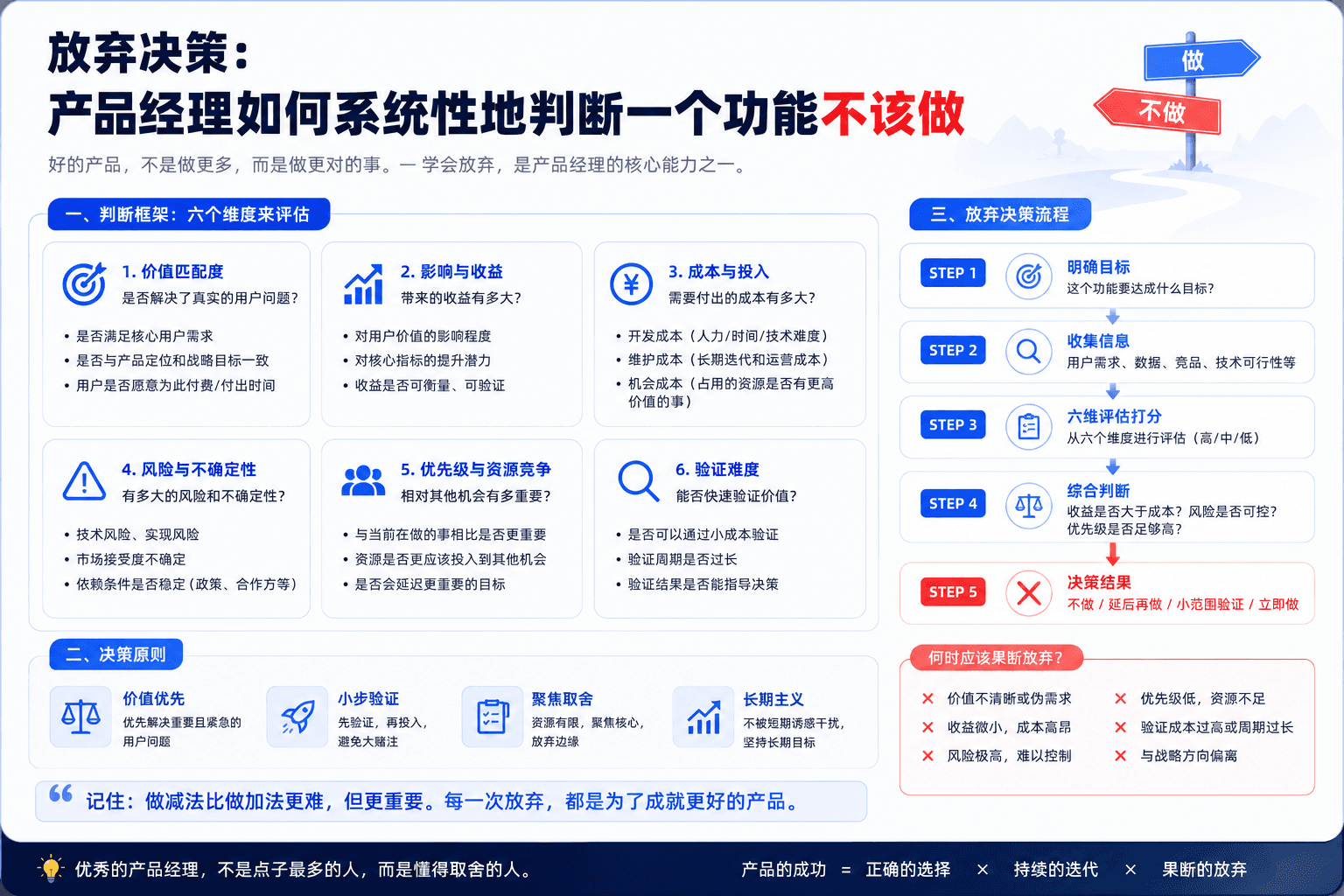
The Art of Abandonment: How Product Managers Decide What Not to Build
Most product managers focus on what to build, but few systematically practice what to abandon. This article introduces a three-gate checklist to help teams actively say no to features that are merely nice-to-have.
A Common Sunk-Cost Trap
Every sprint planning meeting, someone proposes a feature that users “want.” It seems reasonable, technically feasible, and competitors already have it. So it goes into the backlog, ships after a few cycles, and launch day shows zero change in daily active users. When asked why, the PM can’t clearly articulate the original justification.
This isn’t rare. In my own product work and observing other teams, I’ve noticed: most products die not from too few features, but from too many — and nobody dares to say no.
The word “no” is severely undervalued in prioritization. We have models like RICE, WSJF, or Kano to decide what to build, but rarely do we have a checklist to systematically argue whether a feature should be abandoned.
Why Is It So Hard to Abandon?
Three common psychological biases are at play:
- Sunk Cost Fallacy: We’ve already invested discussions, design, even development. Stopping now feels wasteful. But sunk costs should not drive future decisions.
- Confirmation Bias: Someone on the team believes this feature will drive growth, so you unconsciously seek supporting evidence and ignore counter signals.
- FOMO (Fear of Missing Out): Competitors have it; we don’t. This creates anxiety. But competitive analysis only tells what others are doing, not whether we should do it.
The Abandonment Checklist
I designed a simple three-gate process. For each candidate feature F, answer the following. If any gate returns a clear “no,” consider abandoning or at least deferring until more evidence is available.
Gate 1: Core Conflict
Does F directly solve a current, unmet core user need?
The judgment is not based on what users say they want, but on what they do. If behavioral data shows most users get stuck at a critical step and F removes that bottleneck, pass. If F is merely nice-to-have or solves an edge case (e.g., <5% of users complain), fail.
Example (hypothetical): You’re building an AI writing tool for English emails. Users request “more templates.” But analytics show that most users immediately delete the template content after opening the editor and write from scratch. This indicates the real unmet need is personalization, not template quantity. Adding more templates is the wrong solution; prioritize improving the generation model's ability to match user style.
Gate 2: Opportunity Cost
If we build F, what do we not build?
Resources are finite. A team of four developers can only deliver two medium features per sprint. Choosing F means abandoning candidates G and H. Ask yourself: Does G or H have a clearly higher expected value? If F’s expected value is not significantly higher than the average of other candidates, abandon.
You can use a simplified score: Value = (users affected × problem severity) / (implementation cost + maintenance cost). If F scores below the average of current backlog candidates, abandon.
Gate 3: Deferrability
If we don’t build F now, will users significantly churn in three months?
This is the most counterintuitive gate. Many features, even without them, won’t cause users to leave immediately. They may complain, but if the core value holds, they stay — as long as there’s no better alternative. Accepting delayed gratification is a sign of PM maturity.
How to Institutionalize Abandonment
A checklist alone isn’t enough; you need team buy-in. I recommend adding a regular “Abandonment Vote” to your weekly product review. Anyone can nominate a current backlog item or existing feature to be “proposed for abandonment” with a brief rationale. The team discusses, and if a simple majority agrees, it’s officially removed from the roadmap or marked as “no active development.”
In practice, most abandoned features are never missed. The saved time can go into something that truly changes user behavior.
Edge Cases
This checklist does not apply to:
- Compliance requirements (legal/regulatory)
- Security patches
- Technical debt that threatens core system stability
For these, you must proceed regardless of the checklist.
Closing Thoughts
Prioritization is not about choosing what to build; it’s about choosing what not to build. Learning to actively abandon takes more courage than learning to select — because abandonment means admitting previous assumptions might be wrong and making room for higher value.
Next time you face a “nice-to-have” feature, resist the urge to schedule it. Run it through the three gates. You’ll find most features won’t survive the test.
PaxLee