
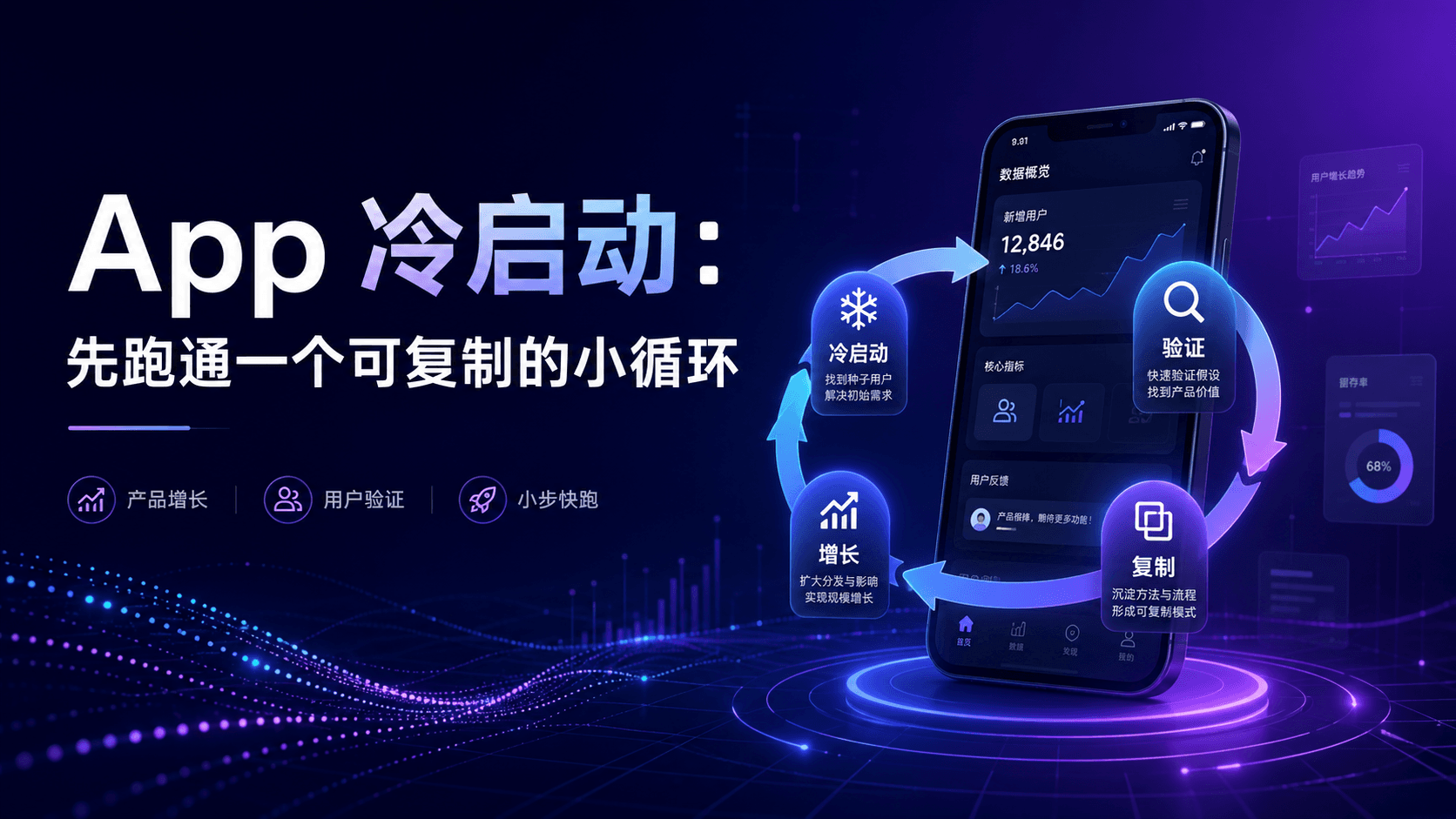
App Cold Start: Build One Repeatable Loop First
A practical operating framework for launching an app from zero: define the first users, the first result, the return reason, and the smallest channel loop before scaling.
Cold start is not the launch day
I do not define an app cold start as getting the first batch of downloads. A download is only an entry point. Many apps do not fail because nobody sees them; they fail because people open them and do not understand why they should continue.
The real object of cold start is a small loop: a specific type of user enters because of a clear promise, completes one key action, receives a visible result, leaves something behind, and has a reason to return or tell someone else. If this loop does not work, ads, PR, and community posts will only enlarge the cracks in the funnel.
So I would keep the goal deliberately narrow. I would not chase broad attention, cover every audience, or turn the first version into a large feature collection. During cold start, I only want to answer three questions:
- Who are the first users, and can their situation be described in one sentence?
- What result can they get as quickly as possible after opening the app?
- Why would they come back next time without an operator pushing them every day?
My shorthand is: one promise, one entry, one key action.
A four-layer cold start framework
1. Acquisition cold start: find a reachable small group first
The first users should not be described with broad labels such as young professionals, students, or creators. Those words are too wide, and operational work will lose focus.
I prefer a concrete situation: people preparing for a specific exam, freelancers who just started taking projects, or users who process the same type of content every day. The important question is not whether the group is large. The question is whether they already talk about the problem somewhere, whether they understand the promise, and whether they are willing to try an imperfect new tool.
The first channels do not need to be many. One community, one practical article, a small set of short videos, or one vertical search keyword can be better than generic traffic. Every entry should have a source marker, even if it is only a different link, invite code, or form field. Without source tracking, you cannot later tell whether the problem is the product or the channel.
2. Activation cold start: reduce choices and make the first action happen
A cold start version often has too many features and an unclear first step. After opening the app, the user journey should be short enough to repeat from memory: understand the value, start the action, get the result, know the next step.
I would place events on the critical path instead of tracking every click: app open, onboarding completed, key action triggered, result received, second session. Product and operations should read these points together, because activation issues are not always copywriting issues. They can come from permissions, loading time, empty states, default settings, or registration friction.
Here is a simple judgement: if a user needs a three-minute explanation before knowing how to use the app, the product is not yet ready to be operated at scale. Operations can clarify, but they cannot permanently carry the product’s comprehension cost.
3. Retention cold start: the return reason must come from the product
Many apps do not fail on the first day. They fail because the second open has no reason. Push notifications, campaigns, and check-ins can help, but they cannot replace a real product-level reason to return.
There are three common return reasons:
- Unfinished work: the user still has something pending, such as a review, confirmation, or submission.
- New value: the app produces new content, reminders, results, or suggestions.
- Accumulated assets: the user has data, templates, records, relationships, or progress inside the app.
During cold start, I would not design a complex retention system too early. I would first confirm that at least one of these reasons is real. If the user loses nothing after leaving, returning depends mostly on chance.
4. Word-of-mouth cold start: ask after the result
I do not like forcing sharing too early. If the user has not received value yet, asking for a share is basically spending their social credit.
The better timing is after the key action is completed. A share page should not only show the app logo. It should show what the user just achieved and why it is useful for the receiver. For apps around privacy, security, or productivity, public sharing may not be natural. Collaboration invites, template exports, reports, or referral codes may fit better.
A 30-day execution rhythm
Cold start needs rhythm. It does not need a new direction every day. This is the 30-day version I would use. The timeline can be compressed or stretched, but I would avoid changing the order too casually.
| Phase | Focus | Output |
|---|---|---|
| Week 1 | Define the audience, promise, and key action | Cold start hypothesis, first-screen copy, key funnel, feedback entry |
| Week 2 | Invite a small batch of users to try it | Issue list, activation blockers, permission and registration fixes |
| Week 3 | Test 2-3 controllable channels | Source records, landing page versions, content material review |
| Week 4 | Decide whether to expand, adjust, or pause | Retention signals, return reason, next iteration plan |
The important part is restraint. In week 3, I would test no more than 2-3 channels. If ten channels start at the same time, the data will be mixed together and the team will not know which variable actually worked.
Do not turn cold start into a noise project
| Common move | Problem | What I would do instead |
|---|---|---|
| Buy broad traffic immediately | It is hard to know whether users match, and activation problems appear fast | Start with one highly relevant situation and verify the key action |
| Ask friends and colleagues to download | It creates a false sense of activity | Ask them to test as target users and record where they get stuck |
| Build many features at once | The team may confuse more features with more value | Keep only what supports the first result |
| Watch only new downloads | Downloads do not prove the product works | Also track key action completion and return signals |
| Stimulate sharing with campaigns | Sharing quality is often low, and user relationships are consumed | Offer a natural share point after the user gets a result |
The most expensive thing in cold start is not traffic. It is the wrong signal. A wrong signal can keep a team investing in a direction that looks busy but does not actually work.
Example: a payment reminder app for freelancers
The following is an example only. It does not represent real project data.
Suppose I want to cold-start a payment reminder app for freelancers. I would not begin with all freelancers. The first group can be narrower: people who take design, copywriting, or development projects and often need to follow up on final payments.
The promise should also be specific: create a project payment checklist in a few minutes and get reminded before the due date. The key action is not successful registration. It is creating the first project, entering one pending payment, and setting a reminder time.
The acquisition entry could be a practical article for freelancers: how to avoid forgetting final payment follow-ups. The article should not push features too hard. It should first explain a payment follow-up workflow, then offer a template or app entry.
The retention reason comes from reminders and project status. The user returns not because an operator sends a message, but because a payment needs confirmation or a project needs updating. Sharing does not have to be a public poster. Exporting a payment checklist template or inviting a collaborator to view project status may be more natural.
The point of this example is not the category. The point is the trade-off: narrow audience, narrow promise, narrow action. Only then does feedback become clear.
Cold start checklist
Before release, I would check these questions one by one:
- Can the first users be described in one sentence?
- When users open the app for the first time, do they know what to do first?
- Does the first screen promise a specific result instead of listing features?
- Is the key action short enough and not dependent on complex setup?
- Does the empty state give a next step instead of only saying there is no data?
- Do registration, permissions, and notifications really need to appear so early?
- Can each channel be identified by source?
- Is there a low-cost feedback entry, such as a form, email, or in-app feedback?
- Are key funnel events recorded instead of only downloads?
- After the user completes the key action, is there a clear next step?
- Is there a real reason to return?
- Has the team agreed on the criteria to continue, adjust, or pause?
I would not use one universal retention benchmark for every app. Tools, content products, social products, and transaction products have different usage frequencies. A more reliable approach is to define the product’s key behavior first, then see whether that behavior repeats within the same type of user.
Signals that cold start is working
Cold start should not remain small forever. It should give the team a decision about whether to invest more.
I would look for four signals. First, a channel can repeatedly bring similar users instead of one accidental batch. Second, new users can complete the key action without manual explanation. Third, users leave assets or tasks that can bring them back. Fourth, feedback starts to converge around the same type of issue, instead of every person being confused about what the product is.
When these signals appear, it makes sense to expand ads, produce more content, or build partnerships. Without them, the harder operations work, the later product problems are exposed.
The goal of cold start is not to make the app look busy. It is to find a small honest engine. It may be small, but if it can repeat, it is worth improving.
PaxLee